Generation Pipeline (Stages 2 & 3)
State-conditioned cell image generation: given a control cell H&E crop, generate the predicted target cell image after a biological perturbation. The pipeline has two stages:
Stage 2 — OT-based perturbation pair construction (
generative_tasks/data_pairing_for_FM/)Stage 3 — Flow-matching image generation (
generative_tasks/spatia_flow/)
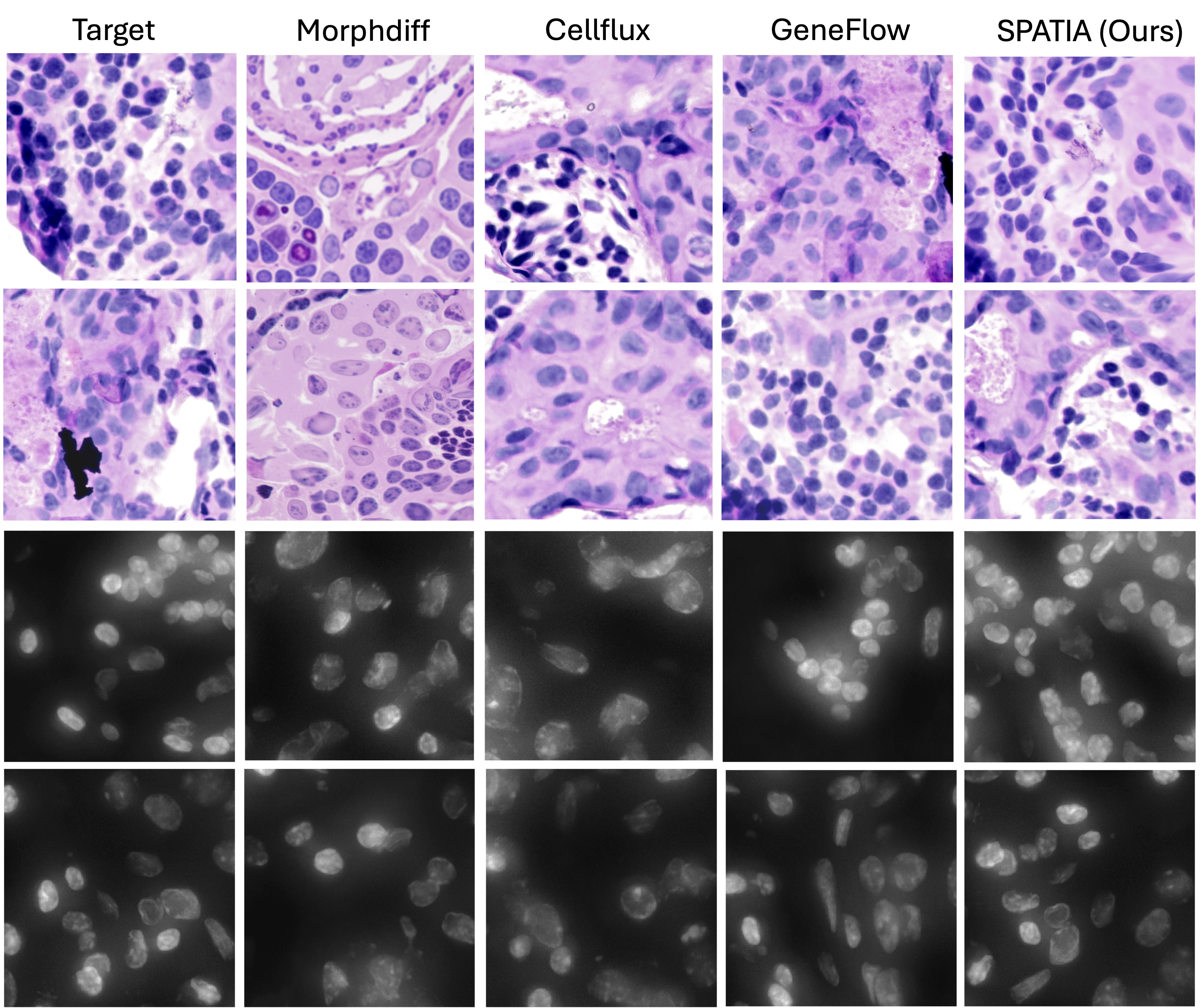
Stage 2: OT-Based Perturbation Pairing
Five biological transitions are modeled across two tasks:
Task 1 — Tumor Progression:
Transition |
Control → Target |
|---|---|
EMT |
Epi_FOXA1+ → EMT-Epi1_CEACAM6+ |
Proliferation |
Epi_FOXA1+ → Epi_CENPF+ |
Lineage conversion |
Epi_FOXA1+ → mgEpi_KRT14+ |
Task 2 — Immune Infiltration:
Transition |
Control → Target |
|---|---|
T-cell activation |
tcm_CD4+T → eff_CD8+T1 |
Angiogenesis |
EC_CAVIN2+ → EC_CLEC14A+ |
Cell-level pairing
cd generative_tasks/data_pairing_for_FM

python generate_spatia_pairs.py \
    --adata /path/to/adata_with_cell_states.h5ad \
    --out_dir ./spatia_pairs_output \
    --lmdb_path /path/to/xenium_he_rep1_192px.lmdb \
    --state_col cell_states \
    --niche_col niche
Or use the convenience script:
bash run_spatia_pairing.sh
Outputs:
spatia_pairs_output/
├── perturbation_pairs.csv      # OT-matched pairs with transition metadata
├── delta_g_signatures.npz      # Per-transition Δg vectors (mean expression shift)
├── delta_m_signatures.npz      # Per-transition Δm vectors (morphology shift)
└── pairing_config.json
Niche-level pairing (grid-based)
python generate_grid_niche_pairs.py \
    --niche_adata /path/to/grid_niche_256_256/DATASET.h5ad \
    --cell_adata /path/to/cell_level/DATASET_cells.h5ad \
    --out_dir ./niche_pairs_output \
    --state_col cell_states \
    --grid_size 256 \
    --min_cells 5 --min_fraction 0.05 \
    --include_ot_confidence
Stage 3: Flow-Matching Image Generation
Pretrained Checkpoints
Download CellFlux pretrained checkpoints from HuggingFace and place them in generative_tasks/spatia_flow/pretrained_checkpoints/.
Configure data paths
Edit generative_tasks/spatia_flow/configs/spatia_bio.yaml:
adata_path:  /path/to/adata_with_cell_states.h5ad
pairs_csv:   /path/to/spatia_pairs_output/perturbation_pairs.csv
lmdb_path:   /path/to/xenium_he_rep1_192px.lmdb
delta_g_npz: /path/to/spatia_pairs_output/delta_g_signatures.npz
delta_m_npz: /path/to/spatia_pairs_output/delta_m_signatures.npz

spatia_model_path: /path/to/spatia-scgpt/checkpoint/
spatia_vocab_path: /path/to/spatia-scgpt/checkpoint/vocab.json
spatia_gene_stats: /path/to/spatia-scgpt/checkpoint/all_dict_mean_std.csv
Training
cd generative_tasks/spatia_flow

# Quick test (single GPU, ~1 min)
python train_xenium_spatia.py \
    --config spatia_bio \
    --batch_size 4 --epochs 2 --test_run \
    --output_dir /tmp/spatia_test_run

# Full training (multi-GPU, ~28h for 100 epochs on 2×H100)
python -m torch.distributed.run --nproc_per_node=2 --master_port=29502 \
    train_xenium_spatia.py \
    --config spatia_bio \
    --batch_size 8 --accum_iter 4 --epochs 100 \
    --output_dir ./outputs/my_experiment \
    --eval_frequency 10

# Resume from checkpoint
python -m torch.distributed.run --nproc_per_node=2 --master_port=29502 \
    train_xenium_spatia.py \
    --config spatia_bio \
    --batch_size 8 --epochs 100 \
    --output_dir ./outputs/my_experiment \
    --resume ./outputs/my_experiment/checkpoint.pth
Note
Use python -m torch.distributed.run instead of torchrun to ensure the conda environment’s Python is used.
Output structure
outputs/my_experiment/
├── args.json                      # Full config snapshot
├── checkpoint.pth                 # Latest checkpoint (supports resume)
├── checkpoint-{epoch}.pth         # Periodic checkpoints
├── log.txt                        # Per-epoch loss (JSON lines)
└── snapshots/{epoch}_0.png        # Generated image grids (ctrl → generated → target)
Evaluation (FID)
python train_xenium_spatia.py \
    --config spatia_bio \
    --eval_only \
    --resume ./outputs/my_experiment/checkpoint.pth \
    --output_dir ./outputs/eval \
    --fid_samples 200
Morphology proxy encoder
The morph proxy encoder (checkpoints/morph_proxy_encoder.pth) is pretrained on cell regionprops features and provides a morphological reference for the conditioning signal. It is included in the repository and loaded automatically via the config key morph_proxy_checkpoint.
To retrain it:
python training/train_morph_proxy.py \
    --lmdb_path /path/to/data/xenium_he_rep1_192px.lmdb \
    --output_dir ./checkpoints
Niche-Level Generation
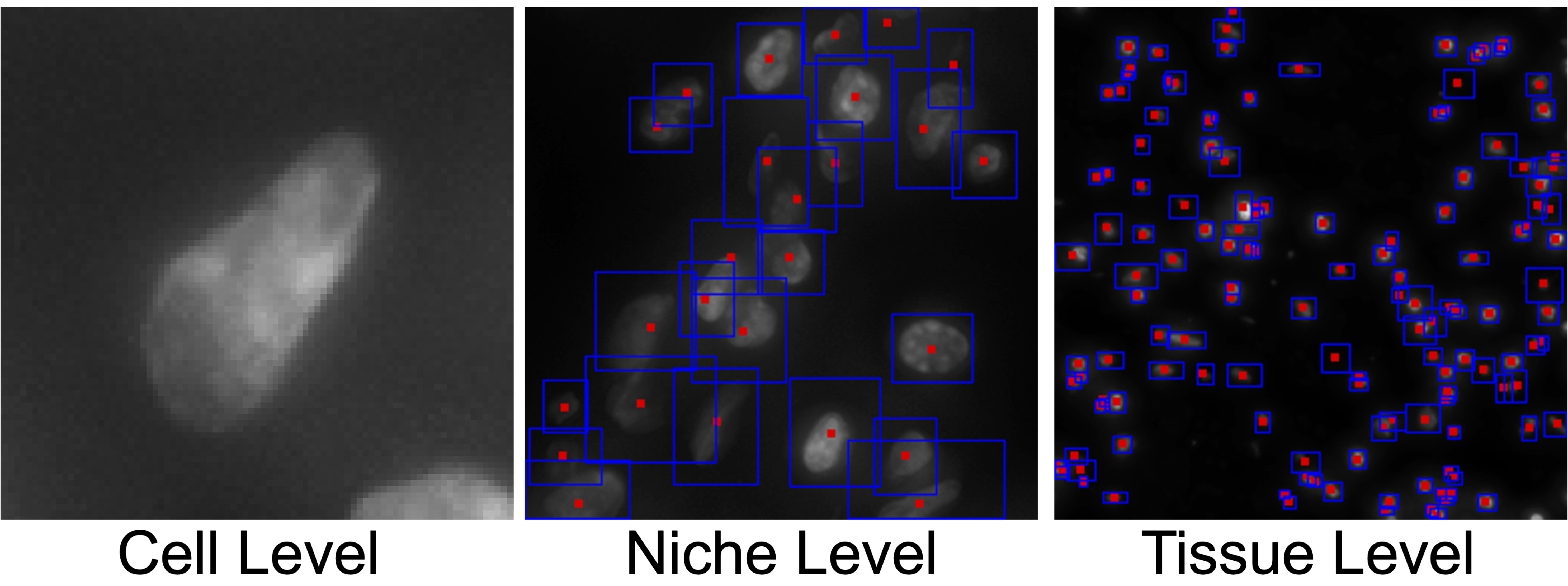
Use niche-level pairs (from generate_grid_niche_pairs.py) with the niche dataset class:
from spatia_niche_dataset import SpatiaNicheDataset, create_niche_dataloaders

dataset = SpatiaNicheDataset(
    adata_path="/path/to/adata.h5ad",
    pairs_csv="niche_pairs_output/niche_pairs.csv",
    delta_g_npz="niche_pairs_output/niche_delta_g.npz",
    wsi_image_path="/path/to/he_image.tif",
    image_size=(512, 512),
)

train_loader, val_loader = create_niche_dataloaders(dataset, batch_size=8)