SPATIA
Multimodal Model for Prediction and Generation of Spatial Cell Phenotypes






Understanding how cellular morphology, gene expression, and spatial organization jointly shape tissue function is a central challenge in biology. SPATIA is a multi-scale model for spatial transcriptomics that:
Learns cell-level embeddings by fusing image-derived morphological tokens and transcriptomic tokens via cross-attention
Aggregates embeddings at niche and tissue levels with transformer modules to capture spatial context
Generates cell morphology images conditioned on predicted state transitions using flow matching
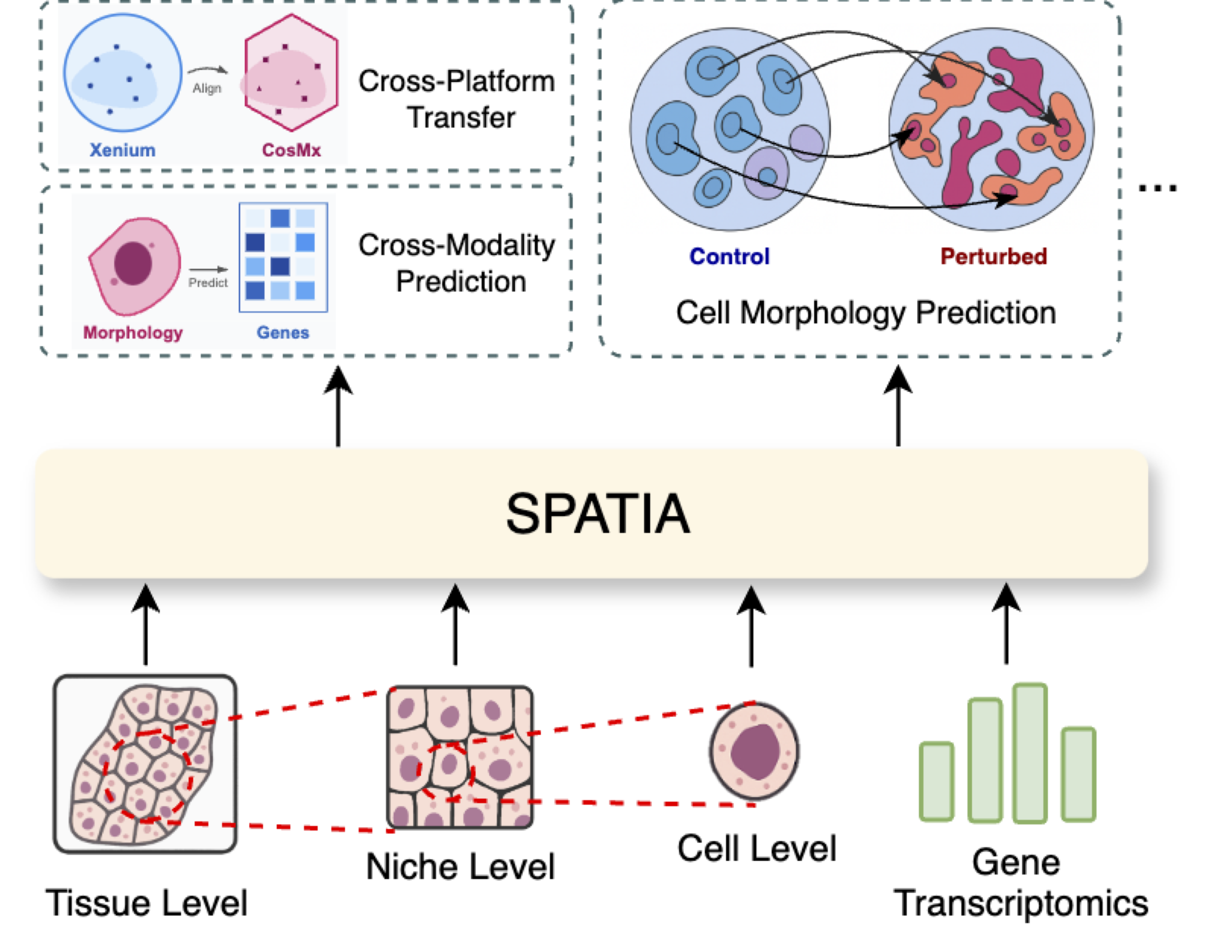
Pipeline Overview
SPATIA is organized as a three-stage pipeline:
Stage |
Component |
Purpose |
|---|---|---|
Stage 1 |
|
Representation learning (scPRINT or scGPT backbone) |
Stage 2 |
|
OT-based perturbation pair construction |
Stage 3 |
|
Flow-matching cell image generation |
Downstream evaluation (clustering, annotation, biomarker prediction) lives in prediction_tasks/.
Getting Started
Data & Training
Downstream Tasks
Reference